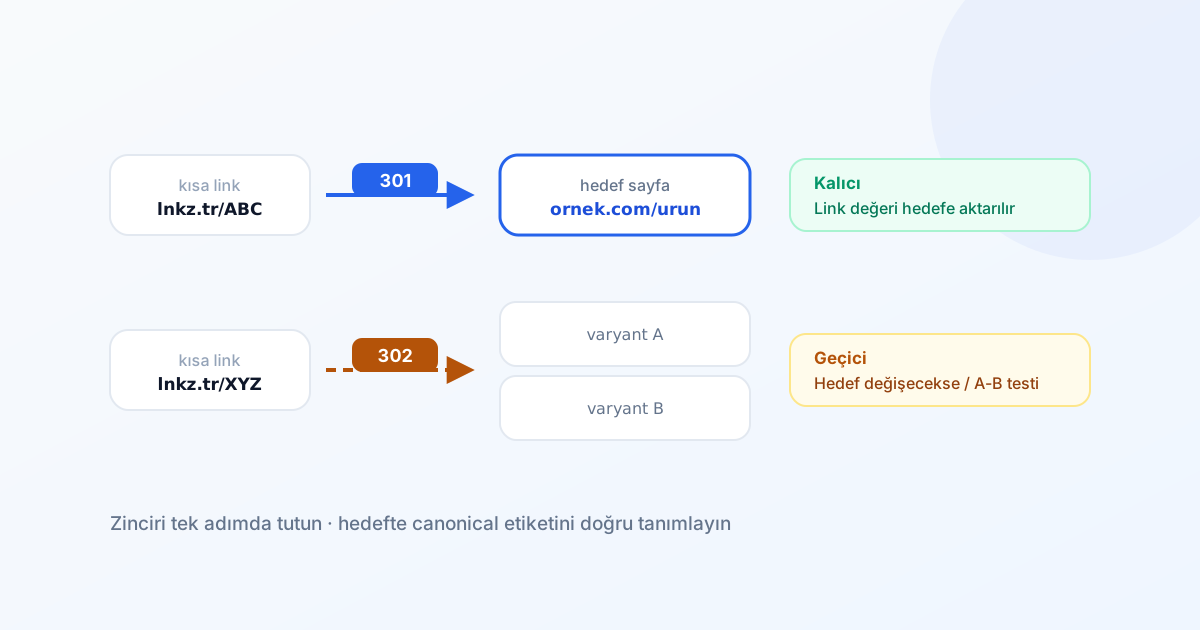
"Will short links hurt my SEO?" The short answer: not if the right redirect type is used. The longer answer lives in the difference between 301 and 302.
Two kinds of redirect
HTTP can express "this address points somewhere else" in several ways. Two matter for shorteners:
| Code | Meaning | Search engine behaviour |
|---|---|---|
| 301 | Moved permanently | Passes link equity to the destination, indexes the destination, caches the redirect |
| 302 | Temporarily here | Hesitant to pass equity, may keep the source address indexed |
Most shorteners use 301, and that is the right default. A short link points at its destination permanently; the intent is not temporary.
Link equity
When another site links to your short link, a search engine follows the 301 and credits the destination page. So these two are practically equivalent from a search engine's point of view:
Direct     : othersite.com  →  example.com/product
Short link : othersite.com  →  lnkz.tr/PRODUCT26  →  example.com/product
Google has said for years that 3xx redirects do not lose PageRank. Two practical caveats remain.
1. Chain length
A chain like short link → old address → new address → https version burns crawl budget and adds a failure point at every hop. Point the short link at the final destination directly; leave no intermediate stops.
2. Canonical tag
Make sure the destination page's rel="canonical" points at its own true address. That keeps the indexed URL stable regardless of how visitors arrive.
When 302 is right
302 is rare but genuinely necessary in some cases:
- A/B testing: the same short link alternates between two pages, so the destination is not permanent.
- Geo or language routing: one link opens different pages per visitor.
- Temporary campaign pages: when the campaign ends you will repoint it at the home page.
- Frequently changing destinations: "this week's offer" style links.
Everywhere else, 301 should be the default.
The hidden cost of 301
Browsers cache 301 responses aggressively. After one click, a browser may go straight to the destination on subsequent clicks without asking the server at all. Two consequences:
- Your click statistics undercount.
- When you change the destination, that user keeps going to the old one for a while.
lnkz.tr therefore attaches a short-lived Cache-Control header to its 301 responses — link equity still transfers, and destination changes take effect quickly.
Should short links be indexed?
No. A short link is a redirector, not a page. It has no business appearing in search results and can compete with the destination. A well-behaved shortener keeps code addresses out of the index and exposes only its marketing pages.
Do not use short links inside your own site
Internal links tell search engines about your site structure; inserting a redirector weakens that signal and adds a pointless HTTP hop. Short links are for links shared outside your site: social media, SMS, email, print, third-party platforms.
Phishing and reputation
Shortener domains are abused, which is why some spam filters and security tools treat certain shorteners with suspicion. Two mitigations help:
- Use a service that shuts abuse down quickly.
- Stick to a single domain in corporate communication so recipients learn to recognise it.
In email marketing there is one more step: using a consistent shortener domain across your sends helps protect deliverability. Switching shorteners every campaign looks suspicious to filters.
Summary
- Use 301 for permanent destinations; equity transfers.
- Use 302 when the destination will change or you are testing.
- Keep the redirect chain to a single hop.
- Set the canonical tag correctly on the destination page.
- Never use short links for internal navigation.
- Stick to one shortener domain for your brand.